October 3, 2026
Animal Welfare & News
Animal Welfare & News
Not every microchip merger has gone smoothly.

Anne Carter of the Labrador Lifeline Trust recounts life with her Labrador Bumble, who lost her sight to GPRA, describing how a new puppy, Becky, helped guide her and how verbal commands let Bumble navigate safely. Bumble lived a full life until 12.5 years old.
Living with a dog losing it's sight
I am frequently asked "What is it like living with a blind dog"? my reply is, it is an experience that I would not have missed as it has taught me so much more about the dog. When Bumble was three years old I began to notice that she had difficulty in judging distances, more especially at twilight, she would go to retrieve an object and miss it.
Later she was diagnosed as having GPRA and I was given the bad news that she would be completely blind in a short space of time.
I was recommended to have another dog to run with her, to alleviate the stress of her increasing blindness. Although at the time I could ill afford another dog, let alone the extra work I was lucky enough to acquire a 14 week old chocolate puppy whose pedigree showed that she came from very calm parents I was very careful how Becky was introduced into the house. We met on neutral territory and gradually Bumble took to Becky and I knew that there was a good chance that all would settle down well.
Becky seemed to know right from the start that Bumble had difficulty in seeing and therefore was always on hand to find the toy that went missing and take it to Bumble. She was quick to sense when Bumble was in danger of running into something, quickly placing herself between the offending obstacle and Bumble and in some cases pushing Bumble out of the way.
One thing you do not realise is that the blind dog will need to know a completely different set of commands. The other thing is the need for the handler to see obstacles that are likely to cause a problem and react before the dog gets into difficulties. The most important thing to realise is that the blind Labrador is not a fool but a highly intelligent dog that does not want to relinquish its independence. It must on no account be shielded from everything, but allowed to develop its own instincts and using the magnificent nose that all Labradors are blessed with to its greatest advantage. I started doing 'go finds' in the garden, hiding bits of kibble and then calling her out to find them. This trained her to use her already sensitive nose to the best effect.
I have heard people say, "Of course with a blind dog you cannot move the furniture and it cannot go into situations that it is not familiar with". I have to totally refute this. I took Bumble to Scotland annually and to stay in a holiday cottage. We also visited houses totally unknown to Bumble. Naturally she was very careful but always wandered round checking for obstacles and then fixing in her own mind where everything was. Like all good Labradors she would find the kitchen first with the water bowl and the food store!
Bumble continued to have her daily walks with the other two girls and was always first at the door for her collar and lead. Once out on the walk I would guide her where necessary using the command 'steady' if there was an impending obstacle. I never realised how many ways there are to say one word, but each intonation told Bumble whether the obstacle was immediate or at a distance. To change paths I merely said 'Up this way' and she learnt that this meant turn either right or left. If the terrain was particularly hazardous for her, as it can be in Scotland on some of the mountain walks I merely use the command 'In behind Missus' and she would keep close to my heels with her nose pushed at the back of my legs, until I used the trigger word 'Okay now' which was her signal that the way ahead was clear.
Obviously all these commands are in addition to the normal sit, stay etc. It is important that they are taught as the dog loses its sight and not afterwards. Bumble would not give a thank you for being placed on a lead on country walks and would argue all the time.
When we went up to Scotland I worried far more than she did! All this was based on her confidence being built up as blindness approached and encouraging her to make the best use of her other senses.
On the down side I have found that she barked more when at home with me. The least little sound and she tended to bark and had to be persuaded that all was well.
I also discovered that Insurance companies will not insure the blind dog for third party insurance. When meeting strangers who do not know the dog it is always advisable to warn them, as Bumble had on occasions walked into people. With the advent of the mountain bike and runners, seen all too commonly on our walks, this can be another unexpected hazard and I had to resort to the final command of 'Whoa' which to Bumble meant 'stop dead'.
The other thing is, some people do tend to put a hand out to the dog, sometimes too quickly and this can be a danger point as a blind dog might just snap in fear. This happened only once in eight years, and it was a delivery man who put his hand up to the stair gate too quickly and Bumble snapped - fortunately it did not connect. He apologised when he realised why - it must be one of the few apologies to a dog for snapping!
When Bumble was first diagnosed I was heartbroken but together with Becky and my rescue dog Purdy, she had a good life and missed out on very little. I was of course very protective of her but in a different sense. I vowed that the day her independence went and she no longer wanted to go out or for a walk - well that would be a different story.
When I hear people say that the dog should be euthanased purely as it has no sight - if it has all other senses and is young enough - I say work together and build another life - the rewards are immeasurable.
Bumble marched on until she was 12.5 years old. It was only after she went that Becky finally relaxed having been her main guide dog for over 8 years.
I have been asked many times for this article to be reprinted in the hope that others may take heart and realise that a blind dog does not know it is blind and we think in human terms. What is catastrophic in a human need not be so in the dog.
Anne Carter
Labrador Lifeline Trust
www.labrador-lifeline.com
Not every microchip merger has gone smoothly.
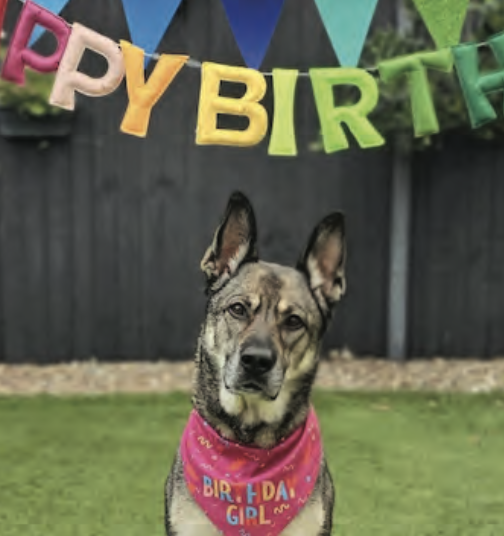
Eight-year-old Harper lost the home and person she knew when her devoted owner became seriously ill. Four months later, after getting a precious taste of family life again in foster care, she is still waiting for someone to choose her.
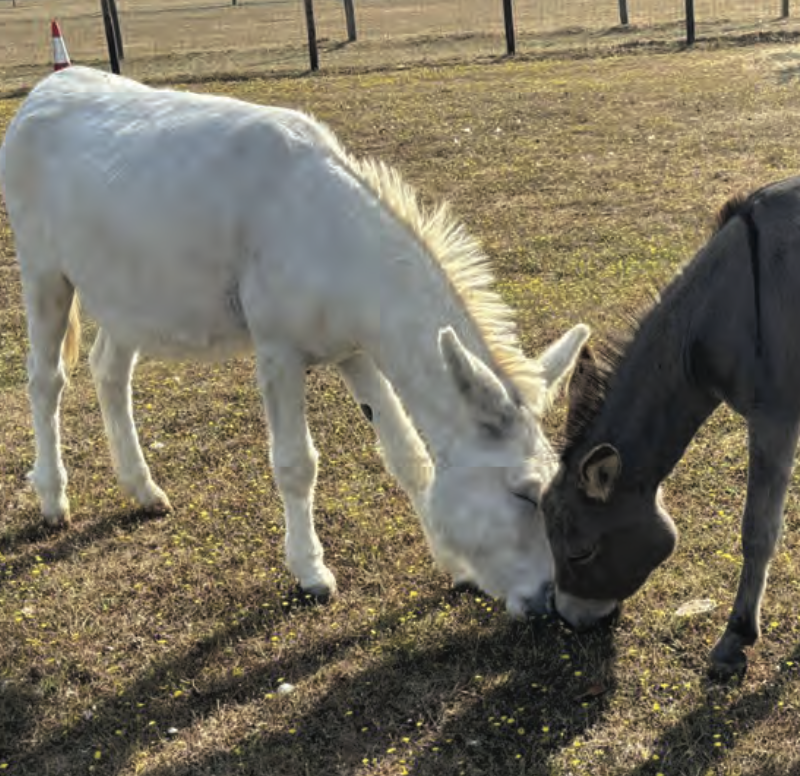
A donkey named Dandi, who was among more than 50 other animals seized by the RSPCA from an address in Essex in 2023, is thriving in the care of The Donkey Sanctuary.